Friday, October 12, 2012

I wish I had the ability.

It wasn't a very loud word, but it had an effect rather like that of a drop of black ink in a glass of clear water. The word spread out in coils and tendrils, getting everywhere. It strangled the noise.

- Going Postal
  Terry Pratchett


Tuesday, September 25, 2012

Suicide in the Trenches

I KNEW a simple soldier boy
Who grinned at life in empty joy,
Slept soundly through the lonesome dark,
And whistled early with the lark.

In winter trenches, cowed and glum,
With crumps and lice and lack of rum,
He put a bullet through his brain.
No one spoke of him again.
. . . .
You smug-faced crowds with kindling eye
Who cheer when soldier lads march by,
Sneak home and pray you’ll never know
The hell where youth and laughter go.

Siegfried Sassoon

Saturday, September 15, 2012

Au Revoir Bombay

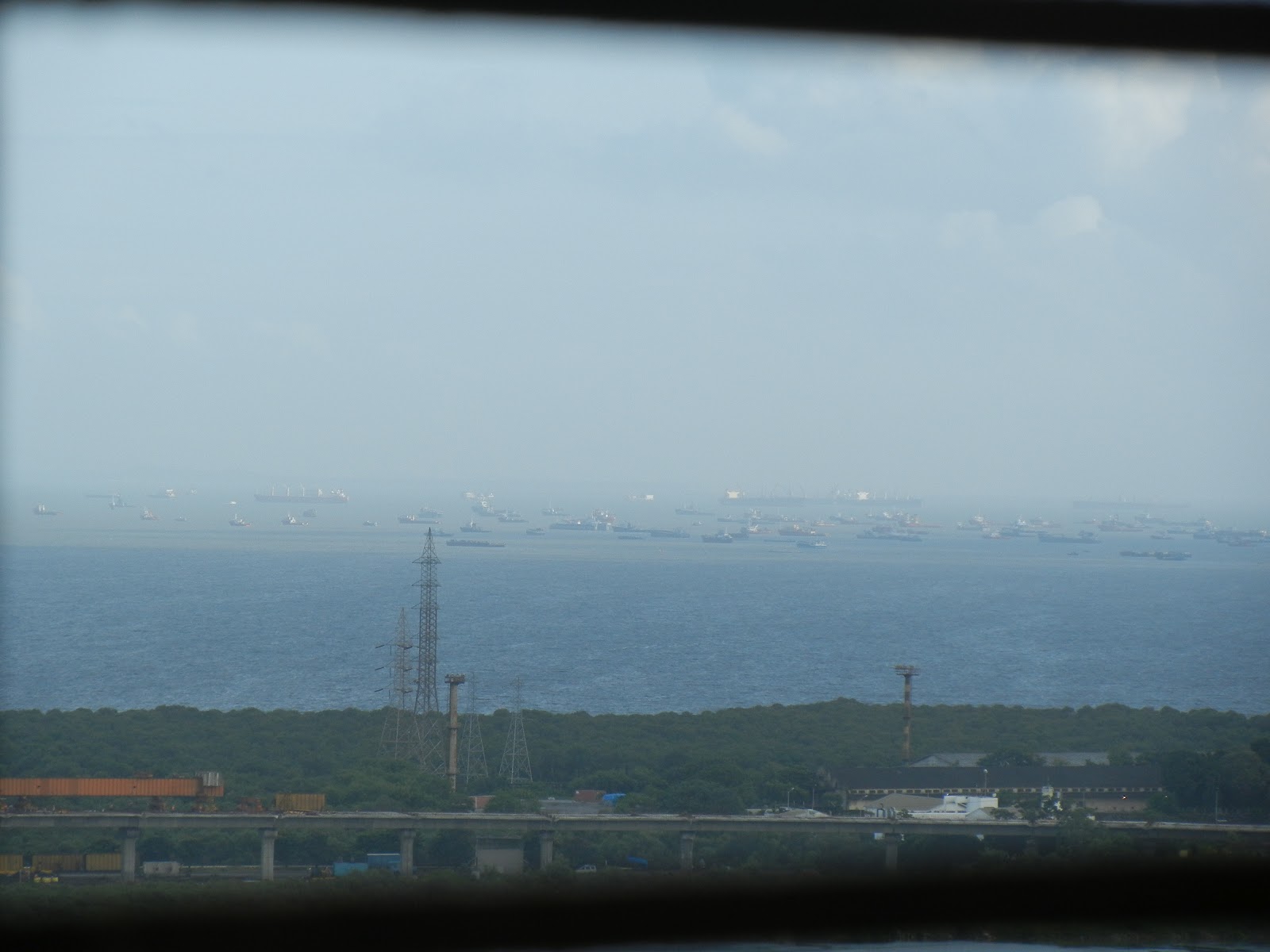
Mordor and the Eye of Sauron - view from flat
On a clear morning - view from flat

After rains - view from flat

All shades and colours - view from flat
VT in the rain

Long Dinners and Great Memories
Waiting for a taxi - The only city in India where queues are formed, sometimes, at certain spots
My weekly headline provider on way to work - the very up-to-date Amul hoarding at Tilak Bridge
Beach and Bridge, Dadar

I will not let Delhi scare me - "jaisi billi maari, vaisi Dilli maari"


Salaam Bombay - Five things I'll miss.

It's my last night in Bombay and these are the five things that I will miss most about this great city:

1. The Parsis

I've found the Parsis fascinating as a people ever since one of my junior school textbooks informed me that Dadabhai Naoroji, the Grand Old Man of India, was a Parsi and all subsequent interactions have only reinforced my fascination. They laid the foundations of the city and continue to be the vortex around which the city revolves; somehow, I believe it is the presence of the Parsis that makes Bombay so different from any other in India - in terms of safety, culture (they turn up in all full force and of all ages at all events at the NCPA) and of course, the urban space that is South Bombay.

The Grand Old Man of India at Flora Fountain
2. King's Circle

Located ten minutes from my flat and on my route back from work, King's Circle provided me with all my necessities - an ATM, a grocery shop, a cobbler, a florist, a miscellaneous items shop, an ice-cream parlour, the chemist and most importantly, a second-hand book spread and Mysore Cafe.

Mumbai does not have very many good, or even just very many book shops. However, one does find the most beautiful second hand books. While King's Circle has many booksellers selling pirated and second hand copies, my favourite book-spread was to the left of Mysore Cafe from 5 p.m. to 9 p.m. and  a most eclectic collection it is . The book-seller is knowledgeable, very helpful and never over-charges. Never having needed to bargain, I have usually ended up buying more books than I ought have but as I mentioned before, some of my favorite buys have been from there, including:
  • Two Historic Trials in Red Fort - an account of the INA Trial and the Trial of Bahadur Shah Zafar complete with all documents including statements, exhibits, opening statements, arguments et al
  • The Adventures of Hajji Baba of Ispahan
  • Hard cover copies of selections of stories by Mark Twain, O. Henry and Guy de Maupassant
  • The Collected DC Comics Absolute Justice
  • Verse by Soviet Poets who laid down their lives in the Great Patriotic War of 1941-1945
  • A Ramayana in Sindhi written in a variant of the Arabic scrip and a Persian Primer
My book-buying was usually proceeded by dinner at Mysore Cafe, one of the many numerous Udipi cafes dotting this area - I grew to prefer it over its rivals for its rasam-vada, its proximity to the books, their providing me with an individual table even if I went alone, their letting me sit for many hours without ordering and for remembering my usual and specific orders.

Cafe Mysore, King's Circle

 Covered from the rain - the book-seller's spot, King's Circle

3. The Taxi Drivers

I have taken the ubiquitous yellow-black cab off the roads of Bombay at all times of the night and day during my stay here and (with a certain amount of luck, of course), I have never faced any problems. In the insane traffic of this city, I have carried on extended conversations with the taxi-drivers and exchanged notes on our experiences in the city and its politics and the state of the country and everything else.  And I have often slept soundly on my way to work on certain days in the confident knowledge the taxi would wind its way to its destination. And though it is almost a daily battle to find a taxi home, I have had, on the whole, a most interesting time with the taxi drivers of Bombay and they will be sorely missed.

I am yet to reach Delhi and I have already been warned time and again against beginning any polite conversations with the taxi- and auto- drivers in Delhi.


4. The Freedom of Movement

No poky neighbours, no judging stares in public spaces and no self-imposed time limits for being out and about town. No other city in India to give that kind of freedom.

5. South Bombay

Everything about it! Marine Drive, Causeway, Mondegar's, Gateway, the Taj, Kala Ghoda, Fountain, VT, Prince of Wales Museum, the Reading Room, Brittania and tree-lined roads to walk along.

Marine Drive

The best place to hang-out late into the night, Marine Drive

Tree-lined avenues, Ballard Estate

The 24-hour open study centre

Boy reading a book, near Cafe Universal, Fort

Wednesday, August 22, 2012

Toba Tek Singhs around the world.

"Only once in the course of this long journey, punctuated by suffering, blood, illness, mud, did she believe she had caught a glimpse of a modicum of serenity and wisdom. She had already reached the far side of the Urals. On the way out of the village half consumed by a fire she saw several men sitting on a bank scattered with dead leaves. Their pale faces turned toward the mild late autumn sun, radiated a blissful calm. The peasant who was driving the cart jerked his head and explained softly, "Poor people, there are a dozen of them wandering around here now. Their asylum was burnt down. Oh, yes, madmen, you know."

- Dreams of My Russian Summers
  Andrei Makine


Thursday, August 16, 2012

65 years of independence...

...and neither India nor Pakistan has a public memorial remembering the partition that created the two countries; nothing in memory of more than 10 million people who lost their lives and their homes and their histories to begin anew in nations that came into existence overnight.

Toba Tek Singh
By Sa'adat Hasan Manto

(See here for the text in Urdu and here for the text in devnagri.)

Two or three years after the 1947 Partition, it occurred to the governments of India and Pakistan to exchange their lunatics in the same manner as they had exchanged their criminals. The Muslim lunatics in India were to be sent over to Pakistan and the Hindu and Sikh lunatics in Pakistani asylums were to be handed over to India.

It was difficult to say whether the proposal made any sense or not. However, the decision had been taken at the topmost level on both sides. After high-level conferences were held a day was fixed for exchange of the lunatics. It was agreed that those Muslims who had families in India would be permitted to stay back while the rest would be escorted to the border. Since almost all the Hindus and Sikhs had migrated from Pakistan, the question of retaining non-Muslim lunatics in Pakistan did not arise. All of them were to be taken to India.

Nobody knew what transpired in India, but so far as Pakistan was concerned this news created quite a stir in the lunatic asylum at Lahore, leading to all sorts of funny developments. A Muslim lunatic, a regular reader of the fiery Urdu daily Zamindar, when asked what Pakistan was, reflected for a while and then replied, "Don't you know? A place in India known for manufacturing cut-throat razors." Apparently satisfied, the friend asked no more questions.

Likewise, a Sikh lunatic asked another Sikh, "Sardarji, why are we being deported to India? We don't even know their language." The Sikh gave a knowing smile. "But I know the language of Hindostoras" he replied. "These bloody Indians, the way they strut about!"

One day while taking his bath, a Muslim lunatic yelled, "Pakistan Zindabad!" with such force that he slipped, fell down on the floor and was knocked unconscious.

Not all the inmates were insane. Quite a few were murderers. To escape the gallows, their relatives had gotten them in by bribing the officials. They had only a vague idea about the division of India or what Pakistan was. They were utterly ignorant of the present situation. Newspapers hardly ever gave the true picture and the asylum warders were illiterates from whose conversation they could not glean anything. All that these inmates knew was that there was a man by the name of Quaid-e-Azam who had set up a separate state for Muslims, called Pakistan. But they had no idea where Pakistan was. That was why they were all at a loss whether they were now in India or in Pakistan. If they were in India, then where was Pakistan? If they were in Pakistan, how come that only a short while ago they were in India? How could they be in India a short while ago and now suddenly in Pakistan?

One of the lunatics got so bewildered with this India-Pakistan-Pakistan-India rigmarole that one day while sweeping the floor he climbed up a tree, and sitting on a branch, harangued the people below for two hours on end about the delicate problems of India and Pakistan. When the guards asked him to come down he climbed up still higher and said, "I don't want to live in India and Pakistan. I'm going to make my home right here on this tree."

All this hubbub affected a radio engineer with an MSc degree, a Muslim, a quiet man who took long walks by himself. One day he stripped off all his clothes, gave them to a guard and ran in the garden stark naked.

Another Muslim inmate from Chiniot, an erstwhile adherent of the Muslim League who bathed fifteen or sixteen times a day, suddenly gave up bathing. As his name was Mohammed Ali, he one day proclaimed that he was none other than Quaid-e-Azam Mohammed Ali Jinnah. Taking a cue from him a Sikh announced that he was Master Tara Singh, the leader of the Sikhs. This could have led to open violence. But before any harm could be done the two lunatics were declared dangerous and locked up in separate cells.

Among the inmates of the asylum was a Hindu lawyer from Lahore who had gone mad because of unrequited love. He was deeply pained when he learnt that Amritsar, where the girl lived, would form part of India. He roundly abused all the Hindu and Muslim leaders who had conspired to divide India into two, thus making his beloved an Indian and him a Pakistani. When the talks on the exchange were finalized his mad friends asked him to take heart since now he could go to India. But the young lawyer did not want to leave Lahore, for he feared for his legal practice in Amritsar.

There were two Anglo-Indians in the European ward. When informed the British were leaving, they spent hours together discussing the problems they would be faced with: Would the European ward be abolished? Would they get breakfast? Instead of bread, would they have to make do with measly Indian chapattis?

There was a Sikh who had been admitted into the asylum fifteen years ago. Whenever he spoke it was the same mysterious gibberish: "Uper the gur gur the annexe the bay dhayana the mung the dal of the laltain." The guards said that he had not slept a wink in all this time. He would not even lie down to rest. His feet were swollen with constant standing and his calves had puffed out in the middle, but in spite of this agony he never cared to lie down. He listened with rapt attention to all discussions about the exchange of lunatics between India and Pakistan. If someone asked his views on the subject he would reply in a grave tone: "Uper the gur gur the annexe the bay dhayana the mung the dal of the Government of Pakistan." But later on he started substituting "the Government of Pakistan" with "Toba Tek Singh," which was his home town. Now he began asking where Toba Tek Singh was to go. But nobody seemed to know where it was. Those who tried to explain themselves got bogged down in another enigma: Sialkot, which used to be in India, now was in Pakistan. At this rate, it seemed as if Lahore, which was now in Pakistan, would slide over to India. Perhaps the whole of India might become Pakistan. It was all so confusing! And who could say if both India and Pakistan might not entirely disappear from the face of the earth one day?

The hair on the Sikh lunatic's head had thinned and his beard had matted, making him look wild and ferocious. But he was a harmless creature. In fifteen years he had not even once had a row with anyone. The older employees of the asylum knew that he had been a well-to-do fellow who had owned considerable land in Toba Tek Singh. Then he had suddenly gone mad. His family had brought him to the asylum in chains and left him there. They came to meet him once a month but ever since the communal riots had begun, his relatives had stopped visiting him.

His name was Bishan Singh but everybody called him Toba Tek Singh. He did not know what day it was, what month it was and how many years he had spent in the asylum. Yet as if by instinct he knew when his relatives were going to visit, and on that day he would take a long bath, scrub his body with soap, put oil in his hair, comb it and put on clean clothes. If his relatives asked him anything he would keep silent or burst out with "Uper the gur gur the annexe the bay dhayana the mung the dal of the laltain."

When he had been brought to the asylum, he had left behind an infant daughter. She was now a comely and striking young girl of fifteen, who Bishan Singh failed to recognize. She would come to visit him, and not be able to hold back her tears.

When the India-Pakistan caboodle started Bishan Singh often asked the other inmates where Toba Tek Singh was. Nobody could tell him. Now even the visitors had stopped coming. Previously his sixth sense would tell him when the visitors were due to come. But not anymore. His inner voice seemed to have stilled. He missed his family, the gifts they used to bring and the concern with which they used to speak to him. He was sure they would have told him whether Toba Tek Singh was in India or Pakistan. He also had the feeling that they came from Toba Tek Singh, his old home.

One of the lunatics had declared himself God. One day Bishan Singh asked him where Toba Tek Singh was. As was his habit the man greeted Bishan Singh's question with a loud laugh and then said, "It's neither in India nor in Pakistan. In fact, it is nowhere because till now I have not taken any decision about its location."

Bishan begged the man who called himself God to pass the necessary orders and solve the problem. But 'God' seemed to be very busy other matters. At last Bishan Singh's patience ran out and he cried out: "Uper the gur gur the annexe the mung the dal of Guruji da Khalsa and Guruji ki fateh jo boley so nihal sat sri akal."

What he wanted to say was: "You don't answer my prayers because you a Muslim God. Had you been a Sikh God, you would have surely helped me out."

A few days before the exchange was due to take place, a Muslim from Toba Tek Singh who happened to be a friend of Bishan Singh came to meet him. He had never visited him before. On seeing him, Bishan Singh tried to slink away, but the warder barred his way. "Don't you recognize your friend Fazal Din?" he said. "He has come to meet you." Bishan Singh looked furtively at Fazal Din, then started to mumble something. Fazal Din placed his hand on Bishan Singh's shoulder. "I have been thinking of visiting you for a long time," he said. "But I couldn't get the time. Your family is well and has gone to India safely. I did what I could to help. As for your daughter, Roop Kaur" --he hesitated--'She is safe too in India."

Bishan Singh kept quiet. Fazal Din continued: "Your family wanted me to make sure you were well. Soon you'll be moving to India. Please give my salaam to bhai Balbir Singh and bhai Raghbir Singh and bahain Amrit Kaur. Tell Balbir that Fazal Din is well. The two brown buffaloes he left behind are well too. Both of them gave birth to calves, but, unfortunately, one of them died. Say I think of them often and to write to me if there is anything I can do."

Then he added "Here, I've brought some plums for you."

Bishan Singh took the gift from Fazal Din and handed it to the guard. "Where is Toba Tek Singh?" he asked.

"Where? Why, it is where it has always been."

"In India or Pakistan?"

"In India...O no, in Pakistan."

Without saying another word, Bishan Singh walked away, muttering "Uper the gur gur the annexe the bay dhyana the mung the dal of the Pakistan and India dur fittey moun."

At long last the arrangements for the exchange were complete. The lists of lunatics who were to be sent over from either side were exchanged and the date fixed.

On a cold winter evening truckloads of Hindu and Sikh lunatics from the Lahore asylum were moved out to the Indian border under police escort. Senior officials went with them to ensure a smooth exchange. The two sides met at the Wagah border check-post, signed documents and the transfer got underway.

Getting the lunatics out of the trucks and handing them over to the opposite side proved to be a tough job. Some refused to get down from the trucks. Those who could be persuaded to do so began to run in all directions. Some were stark naked. As soon as they were dressed they tore off their clothes again. They swore, they sang, they fought with each other. Others wept. Female lunatics, who were also being exchanged, were even noisier. It was pure bedlam. Their teeth chattered in the bitter cold.

Most of the inmates appeared to be dead set against the entire operation. They simply could not understand why they were being forcibly removed to a strange place. Slogans of 'Pakistan Zindabad' and 'Pakistan Murdabad' were raised, and only timely intervention prevented serious clashes.

When Bishan Singh's turn came to give his personal details to be recorded in the register, he asked the official "Where's Toba Tek Singh? In India or Pakistan?"

The officer laughed loudly, "In Pakistan, of course."

Hearing that Bishan Singh turned and ran back to join his companions. The Pakistani guards caught hold of him and tried to push him across the line to India. Bishan Singh wouldn't move. "This is Toba Tek Singh," he announced. "Uper the gur gur the annexe the be dyhana mung the dal of Toba Tek Singh and Pakistan."

It was explained to him over and over again that Toba Tek Singh was in India, or very soon would be, but all this persuasion had no effect.

They even tried to drag him to the other side, but it was no use. There he stood on his swollen legs as if no power on earth could dislodge him. Soon, since he was a harmless old man, the officials left him alone for the time being and proceeded with the rest of the exchange.

Just before sunrise, Bishan Singh let out a horrible scream. As everybody rushed towards him, the man who had stood erect on his legs for fifteen years, now pitched face-forward on to the ground. On one side, behind barbed wire, stood together the lunatics of India and on the other side, behind more barbed wire, stood the lunatics of Pakistan. In between, on a bit of earth which had no name, lay Toba Tek Singh.
Translation taken from: http://www.sacw.net/partition/tobateksingh.html

________________________________________________________________________________

In a recent interview, Manto's niece, Ayesha Jalal, mentioned that “Nothing worried us more than the prospect of the government of Pakistan slapping an award on him. There is a quote from Manto where he says that he shudders to think they might put a thamga (a posthumous medal) on his coffin. We are all very relieved they haven’t given him a national award, posthumously.

Pakistan announced the award of the Nishan-e-Imtiaz to Manto on August 13, 2012.  

Thursday, August 9, 2012

Ramzan Special - Plato Spotting and Gorging in the by-lanes of Mumbai.

To add to a previous post, here's Shahi Aflatoon spotted at Mohammed Ali Road, Mumbai during the month of Ramzan.


I didn't get the chance to try the Plato special but we did have a most filling and wonderful dinner in a most festive atmosphere.


I have a sweet tooth and I wish I'd gone a little slow on the dinner and kept space for the many varieties of desserts available - including many that I hadn't heard or seen before! But maal-poora is one of my favorite dishes, and Ramzan is occasion for this special maal-poora (the photo below), the size of the dinner plate with phirni. What a perfect end.


Ramzan Mubarak!

Wednesday, August 8, 2012

The Inglorious End.

ab tak dil-e-khush_feham ko tujh se hain ummeedain
ye aakhari shammain bhi bujhaane ke liye aa
(The full ghazal here.) 

Bottom of the pool and dare one even say anything about the 11th-12th placements. It's not so much the placements that hurt but that there never even seemed to be a fight. 

Well, here's wishing the Germans the Gold now.  

Tuesday, July 31, 2012

Those Damnable Dutch and Indian Hockey and me.

The Olympics are upon us and after the horror of Beijing where India did not qualify for hockey for the first time ever since their first appearance, just making it to London made us Indian hockey supporters breathe a sigh of relief. Do we expect to have a podium finish? No, not very seriously . And yet, the match today exceeded everyone's expectations such that we began to expect a win and were disappointed to not, at the very least,  equalize. Against Netherlands.

Perhaps we have lost more and lost worse to other teams but Netherlands remains in my memory as the nemesis of Indian hockey. I don't recall the tournament now. India playing against the Dutch were, for once, leading 3-0 with 7 minutes left on the clock. And then the electricity went. We rushed to a radio. By the time it was brought out and the correct wavelength identified, Holland had equalized! And as we heard, they scored again and had won the game 4-3 (You can see it all here). I have disliked the Dutch team ever since; in my head, Netherlands (more than Australia) has been a big bad wolf.

My loyalty was given to hockey at a young age, heavily influenced by tales told by Dad and Chachaji of the hockey games they played in and the hockey games they'd seen during their school days. Perhaps it helped that Indian cricket was also quite at its nadir in those formative years, though I would like to believe that my heart would have been given to hockey irrespective of its competitors.

My father went to a public school that shared its hockey practice grounds with the Indian team. He fondly remembers the time(s?) the school team played against the Indian team and proudly narrates the story of Surjit Singh's frustration at letting a school kid get past him and therefore taking him down^ - apparently, Surjit Singh's philosophy was that either the ball would get past him or the man, never both.

So I grew up on tales of hockey and history (the Indian glory at the Olympics*, the golden years that lasted till the late '60s, the last of the great wins of the 1975 World Cup), the turn to astro-turf, the loss of the art of dribbling and the fall of the (sub-continental) game. Despite it all, through the horrible 90s of my childhood, hockey remained the preferred sport.

Tonight, a young team on a blue turf they've barely played on, having only a few players with any Olympic experience, played well. Certainly not well enough but though they did not win, they helped put a few personal ghosts to rest. It was one match and it is one small sign but in my imagination finally the Dutch no longer seem invincible and larger-than-life.

There are five more games to go and only two teams to make the next round and all that India realistically hopes for is making the top six. The Indian Hockey Federation and its politics are still dirty, the Indian team is still mercurial, their game still fairly slow, and how the future will play out, through the Olympics and beyond, shall be revealed in time. Yet, for today, Michael Nobbs' boys seem to have a fresh energy and a spring in their step not often seen in the Indian team. For now, that is enough.  
__________________________________________________________________

*a clip of the India-Germany final in 1936, which India won 8-1
^ Ajit Singh's reaction: Kyon jawaak nuun kutti jaana hain? [Why are you beating up/going after a kid?]

Thursday, July 19, 2012

Acersecomic

Brain Pickings Weekly's Unusual Words Rendered in Bold gives a useful word for me to know:

Acersecomic: A person whose hair has never been cut.  


And World Wide Words gives this further information:

"The legitimacy of this word rests entirely on two appearances in dictionaries, in 1623 and 1656. It seems never to have been used seriously and ever since has been held up as an example of an odd word, in modern times in works with titles like The Joy of Lex,Poplollies and Bellibones, Have a Word on Me, and Dimboxes, Epopts, and other Quidams.

It means a person whose hair has never been cut. Though that may appear comic to some, there’s nothing humorous in its etymology. The word is from the classical Latinacersecomes, a long-haired youth, a word borrowed from an earlier Greek one that was made up from kome, the hair of the head (which is where comic comes from in the ending), keirein, to cut short, and the prefix a-, not. Though this sounds like a aged curmudgeon’s way to talk about unkempt youngsters who weren’t like that in his day, it was actually neutrally descriptive — it was usual for Roman and Greek youths to wear their hair long until they reached manhood.

Greek kome has given us one sense of coma: a diffuse cloud of gas and dust that surrounds the nucleus of a comet. The same -comic ending turns up in two terms that, if possible, are even rarer: acrocomic, having hair at the tip, as in a goat’s beard (acro-means tip) and xanthocomic, a person with yellow hair (from Greek xanthos, yellow)."

Xanthocomic Acersecomic.

Thursday, July 12, 2012

Flagging a cab.

It was a Clark Gable day again today.


It's not hitchhiking but some days, willingness to pay the fare (and even extra) is no guarantee of a ride. Nothing works - not the smiling face or the long face or the crazy arm waving or jumping up and down or even the tried and tested thumb. And I can't decide whether to curse more the cabs which whizz right past or the ones who make a pretense of slowing down and raising hopes and move on before I've even finished saying my destination.

Tuesday, July 3, 2012

The Trams of Calcutta


Tera mujh sey hai pehley ka naata koi
Yun hi nahin dil lubhaata koi...

I fell in love with trams the first time I visited Calcutta in January 2009. Calcutta being the only city in India to currently have trams, it was the first time I ever saw one in operation or rode one. Actually, rode many. As many as I could convince my friends to take. I recently visited again and many of the routes plying in 2009 have closed. We took two routes this time, from Tollygunge to Kalighat and Esplanade to Kidderpore, and in the sweltering heat of June, the tram was the coolest way to travel.

The history of tram transport in India goes back to the 1870s when trams were introduced in Calcutta and Bombay and subsequently in Delhi, Madras, Patna, Nasik and Kanpur. Delhi and Bombay were the last to hold out, shutting down in the 1960s. The Calcutta tram survived and is the oldest operating electric tram in Asia, running since 1902.


I was most surprised (and irritated) to find that no tram souvenirs were available anywhere in the city. No postcards, no magnets, no t-shirts. (What shops do sell is the Victoria Memorial, some Howrah Bridge and lots and lots of, of all things, the Taj Mahal (Agra)). 

Oh it hurts me just to see 'em
Going dead in a museum
- Robyn Hitchcock, Trams of Old London 

Where trams go to die - Tollygunge Tram Depot


Ram Rattan Singh, who has been driving trams for 32 years


My love for trams is not an isolated phenomenon...


...and thankfully, they seem to have made a comeback in many cities around the world in the past couple of decades, including London in 2000. One can only hope that the Indian government will catch on and the Calcutta trams especially will also be remembered and cared for and regain their glory.

Monday, July 2, 2012

Now that it's over

"Well, of course, classically, gods play with the fates of men, so I suppose there is no reason why it shouldn't be football. We play and are played and the best we can hope for is to do it with style."

- Unseen Academicals
  Terry Pratchett

Monday, June 18, 2012

Incorrigibly Plural.

Snow

The room was suddenly rich and the great bay-window was
Spawning snow and pink roses against it
Soundlessly collateral and incompatible:
World is suddener than we fancy it.

World is crazier and more of it than we think,
Incorrigibly plural. I peel and portion
A tangerine and spit the pips and feel
The drunkenness of things being various.

And the fire flames with a bubbling sound for world
Is more spiteful and gay than one supposes –
On the tongue on the eyes on the ears in the palms of one's hands –
There is more than glass between the snow and the huge roses.

- Louis Macneice

Saturday, June 16, 2012

Language - drifting around the world

I recently learnt that the fruit known as the chickoo in North India and sapota in South India is called ‘chicozapota’ in its native Mexico!

One of the other fascinating discoveries in my life has been the knowledge that many things with the sound "chi" in their name came from China! So we have:
  1. The Lychee - native to southern China and South East Asia
  2. Daal-chini - which I have always translated as cinnamon but apparently what is native to China is the Cassia. Cassia is generally a thicker bark with darker coloration, though is often confused with cinnamon. I don't know which one is actually used at home, but at some point its name source is definitely Chinese.  
  3. Chenab -  In popular lore, the river got its name because its source was assumed to be somewhere over the mountains in China (Chin-ab - Waters of China)*
I don't understand why cheeni is cheeni though (I mean sugar, not a Chinese person).
___________________________________________________________________________________
*The other story for the origin of the name of the river is its tributaries, Chandra and Bhaga, which have their confluence at the village of Tandi. I like Chin-ab better. 

Friday, June 8, 2012

Firangi, Gora and Vilayati

A recent conversation made me realize that I tend to use the word firangi while talking about white tourists in India and got me thinking about the other words used for them. My knowledge is restricted largely to Punjabi, but at least for north India, I think the list below would be almost if not fully exhaustive. Where I did get stuck was in figuring out the difference in the usage for the terms, especially firangi and gora.*


Firangi  - Along with gora, the more common word used to describe a foreigner. I had always assumed that word's origin was fi-rang - other coloured. But it appears I was wrong.  Wikipedia informs that the word is not just used in the Indian sub-continent, but across much of the middle-eastern world:

"Because the Frankish kingdom (Francia, the name origin of "France") dominated Western Europe for centuries, terms derived from "Frank" were used by many in Eastern Europe, the Middle East, and beyond as a synonym for Latin Christians or Western and Northern Europeans in general."

The french, though, also have their own specific word in the sub-continent - francisi. 

Gora (f. - Gori) - White-complexioned. According to the Concise Hobson-Jobson, the word referred to any European who was not a sahib, 'sahib' being used when "no disrespect was intended". (Now of course, we are masters of our own fate and no longer use the word for the white man; instead we use it to obsequiously address our government masters who possibly hold more power than their pre-independence compatriots in ruining lives).

Even though Hobson-Jobson may consider the term not a very polite one, it means a fair complexion and is used to refer to fair skinned Indians also. Surinder Kaur singing about the chaos caused by the gori and her jhanjraan (anklets) is quite a Punjabi favourite (our unhealthy obsession with fair skin notwithstanding, it is a beautifully sung song).

Vilayati is the equivalent of the hindi Videshi - a foreigner,  and comes from the arabic wilayat meaning 'a kingdom, a province' and in Hindustani is used to indicate "any imported article or good", including a person. It also gave rise to the English term Blighty for their homeland, as in "Fifty of the 76 escapees were summarily shot by the Gestapo on Hitler's orders, and only three (none British) made a successful "home run" to Blighty."

And though vilayati-pani means soda-water, frangipani apparently has no connection with India. I clarify only because I assumed it did and meant the same thing as vilayati-pani. Frangipani is the common name of the flower Plumeria, known in the subcontinent as champa, and gets its name from an Italian marquess 

Hobson-Jobson also gives the term "Blatty", again derived from vilayati, for two plants in south India, the Hydrolea zeylanica and the Sonneratia acida, though I can't figure out why - with my limited botanical understanding, they both seem to be native to this side of the world (unlike the vilayati-baingan or the tomato). 

Angrej (Angrez) (f. - Angrejan) - Strictly speaking, refers to an Englishman but colloquially can be used to refer to any foreigner. If you try and act too cool, you might get to hear "Baala angrej ban dae" (You think you're an Angrej?) in Punjabi.
   
Englandi - Used specifically for a resident of England, irrespective of ethnicity, race, color etc., as demonstrated by one of the pater's friends known to me only as Englandi. Yes, he lives there.

The question still remains - when do you use which term? And I don't know the answer. Sometimes one, sometimes the other term comes more easily to the tongue. Shah Muhammad's epic on the Anglo-Sikh wars is titled Jangnama - Singhan tey Firangian (Book of War - the Singhs and the Firangis.)  and while firangi is the more common word used by him, he also uses gorey and angrej. Perhaps there isn't and never was much difference between a firangi and a gora.

To sign off, a white man's views on considering himself a firangi:

Since my first visit to India over ten years ago, I have grown increasingly fascinated by the word firangi. To translate it simply as ‘foreigner’ doesn’t do it justice. The Hindi videshi is a world away, quite literally, from firangi, a Mughal-era Persian makeover of ‘Frank’ (or Frenchman). My former Hindi teacher, who favours a chaste Sanskritised language purged of all alien interlopers, grimaces whenever she hears the word. She considers firangi an impure term, a linguistic foreign body that has illegitimately become Indian. But that impurity is precisely what I love about the word firangi. And it is also why I consider myself a firangi, not a videshi. I am a foreigner, but I also am not: my time in India has transformed me, changing how I speak, how I think, what I wear, what I eat, the music I listen to. Slowly but surely, like the word firangi itself, main Hindustani ban raha hoon.’ 

For the rest of the interview with Jonathan Gil Harris, read here.
__________________________________________________________________________________
*These terms are, as far as I know, used only for the white western people. For people of all other regions of the world and India, I don't know if we have any politically-correct words at all.

Rabb

Professor Mohan Singh was the first Punjabi poet that I was introduced to by my grandmother who brought home Saavey Pattar and spent many summer afternoons taking us through it. The poem below is one that she recited often but it didn't mean anything to my 8 year old self. It had completely slipped my mind until the other day when I remembered the first two lines out of the blue. And so I finally read it.

The complete poem is here.

ਰੱਬ
ਰੱਬ ਇੱਕ ਗੁੰਝਲਦਾਰ ਬੁਝਾਰਤ
ਰੱਬ ਇਕ ਗੋਰਖ-ਧੰਦਾ ।
ਖੋਲ੍ਹਣ ਲੱਗਿਆਂ ਪੇਚ ਏਸ ਦੇ
ਕਾਫ਼ਰ ਹੋ ਜਾਏ ਬੰਦਾ ।
ਕਾਫ਼ਰ ਹੋਣੋ ਡਰ ਕੇ ਜੀਵੇਂ
ਖੋਜੋਂ ਮੂਲ ਨਾ ਖੁੰਝੀ
ਲਾਈਲੱਗ ਮੋਮਨ ਦੇ ਕੋਲੋਂ
ਖੋਜੀ ਕਾਫ਼ਰ ਚੰਗਾ ।


Rabb
"Rabb ik gunjaldaar bujaarat - God's an entangled riddle
Rabb ik gorakh-dhanda - God's a labyrinth of complications
Kholan laggiyan pech eis dey -  Trying to understand God's workings
Kaafir ho jaaye banda. - Turns man into an unbeliever (kaafir).
Kaafir hono dar key jee vein - And so even though you live in the fear of becoming a kaafir
khojon mool naa khunji  - But don't ever give up on your questions
Laayilagg momin dey kolon - Rather than being a credulous believer
khoji kaafir changa." - It is better to be a questioning kaafir.

Tey jey tuhaanu samajh aa vi gayi, taan pher ki hoya, for as Bulleh Shah says:

“Gal samajh layee tey raolaa keeh ey,
Eyh Raam, Raheem tey Maula keeh ey.”

Monday, June 4, 2012

Operation Blue Star - June 1984.


The Darbar Sahib (the Golden Temple) has played a central role in all of Sikh history. It has been attacked, destroyed and desecrated and it has been built afresh each time. It is a potent symbol of Sikhism, and along with the turban, the most recognizable. Equally important, though less known to the wider world, is the Akal Takht. Standing opposite the Darbar Sahib, the Akal Takht is the political seat of Sikhism that has stood, in popular imagination and historically, as a challenge to the power of Delhi.

The day Operation Blue Star began was the martyrdom day of Guru Arjun Dev, the 5th Guru of the Sikhs, who built the Darbar Sahib. To any one with the least knowledge of Sikh history, an immediate parallel would be Ahmed Shah Abdali's attack on the Darbar Sahib on Baisakhi in the 18th century. There were innocent pilgrims inside, more so than on any other day, and it would be futile to argue that the Indian Government was unaware of the importance of the day for the Sikhs, which would mean that it was either stupid or deliberate in choosing that day for launching its attack.

The Sikh Reference Library went up in flames after the complex was in control of the Indian army. The Indian government has admitted that certain Sikh records from the library are in the possession of the army, yet they have not been returned or catalogued.

"The soldiers were in a foul mood. According to the official White Paper, 83 army personnel had been killed and 249 wounded during the Operation. Private estimates give much higher figures of army casualties.238 After the destruction of the Akal Takht, they drank and smoked openly inside the Temple complex and indiscriminately killed those who were found inside. For them, every Sikh inside was a terrorist. According to the official White Paper, 493 terrorists were killed, 86 wounded and 1,592 apprehended during the Operation. These numbers add up to 2171, and fail to explain what happened to at least five thousand pilgrims who were trapped inside when the Operation began. The eye-witnesses claim that "7 to 8 thousand people were killed". Mark Tully estimates that approximately 4000 people may have died. Chand Joshi suggests 5000 civilian deaths.239" (Ram Narayan Kumar, The Ghalughara: Operation Blue Star - A Retrospect) 

Bhindranwale, the ostensible reason for Operation Blue Star, was a creation of Indira Gandhi and became her nemesis. He became a power in Punjab politics because of Indira Gandhi's patronage and became a hero and martyr in the wider Sikh imagination because of Operation Blue Star. Getting rid of Bhindranwale was not a good enough reason for the attack, not when other options were available, not when other opportunities were ignored.

"Until June 1, 1984, Jarnail Singh Bhindranwale held his regular public meetings on the roof of the community kitchen inside the Golden Temple complex. The meetings were open to all, and it should have been possible for a group of commandos to nab him there by using minimal force. This was not done. It should also have been easy for specially trained sharp-shooters, who had positioned themselves on the buildings around the temple, to target Bhindranwale and his armed followers, and to "neutralize" them. On June 1 afternoon, mixed groups of various security agencies that had occupied the multi-storied buildings in the circumference did open fire against the temple complex when Bhindranwale was holding his audience on the roof of the kitchen building. Instead of targeting Bhindranwale, the sharp shooters aimed at various buildings, including the main shrine of Harmandir Sahib which received 34 bullet marks. The objective of the barrage of firing, which lasted seven hours, was to assess the strength, the training and the preparedness of Bhindranwale’s resistance." (Ram Narayan Kumar, The Ghalughara: Operation Blue Star - A Retrospect)

What was felt strongly by the Sikhs and has not been recognized by most of the rest of the country is the fact that Operation Blue Star was not so much about taking out Bhindranwale but an attack on the Sikh psyche - on their confidence and their spirit. Indira Gandhi considered it a political game, a good enough cause to consolidate her position by rallying the nation against a common enemy, which was not so much Bhindranwale, but any Sikh who did not conform to and accept the idea of India as dictated by Delhi. And what has also perhaps not been recognized is the fact that even though it happened before I was born, Operation Blue Star will always haunt me, will make me consider Indira Gandhi a complete failure as a national leader and make me question my rights and position in my country because I belong to a minority, and this does not make me a Bhindranwale supporter.  

"As I already observed, the attack on the Golden Temple, the destruction of the Akal Takht, and the atrocities that followed the army operations produced in all sections of the Sikhs a sense of outrage that was hard to alleviate. In any case, appeasement was not even attempted. The large majority of Hindu India, even if politically hostile to Indira Gandhi, openly identified with - and exulted in - her Will to overwhelmingly humble a recalcitrant minority. The sentiment was echoed by Morarji Desai, the former Prime Minister who had led the democratic coalition which replaced Indira Gandhi’s Emergency regime in March 1977: "Nation would have been destroyed if the army had not been moved in. All the terrorists have not been finished yet. They should be liquidated as they are maligning the image of the Sikhs and pose a fundamental threat to the very existence of the country."247 (Ram Narayan Kumar, The Ghalughara: Operation Blue Star - A Retrospect)

The attack on the Golden Temple Complex was a state-sponsored action and like all state-sponsored actions in India, there has never been a public accounting. After all, who is clean enough to point a finger at anyone else? The only other national party, the BJP, is desperately trying to put behind its own state-sponsored terrorism in Gujarat in 2002 and project its perpetrator, Narendra Modi, as the next national leader – and Gujarat is a more recent occurrence and within people’s proverbially short memories.

It is easy to tell people to move on. They have no choice but to move on; the necessity of life makes it so. Yet moving on is not the same as achieving closure. And the Indian Government has always failed in providing that. It is not sufficient to make a Sikh Prime Minister apologise to his own people.

Here is the complete piece, extracts of which are quoted above, by Ram Narayan Kumar on Operation Blue Star.

Wednesday, May 16, 2012

Postal Music

I love the post and everything that is connected with it - the stamps, the postcards, post offices, the postman, the waiting for a letter that you know has been posted, and the surprise of receiving one that you didn't expect. And while many a letter that I have posted (especially the ones with the pretty stamps) has lost its way and I have failed to receive others, the romance of the post continues to hold me in its sway.

Here's a beautiful piece of music created to pass the time while doing the mind-numbing job of stamping letters:

Canceling Stamps at the University of Ghana Post Office

"These postal workers hand-canceling stamps at the post office of the University of Ghana are making drumming sounds, and two are whistling; but there are no drums, and the workers are just passing the time. How, exactly? Koetting (Titon 1992:98-99) wrote as follows:

Twice a day the letters that must be cancelled are laid out in two files, one on either side of a divided table. Two men sit across from one another at the table, and each has a hand cancelling machine (like the price markers you may have seen in supermarkets), an ink pad, and a stack of letters. The work part of the process is simple: a letter is slipped from the stack with the left hand, and the right hand inks the marker and stamps the letter...

This is what you are hearing: the two men seated at the table slap a letter rhythmically several times to bring it from the file to the position on the table where it is to be cancelled. (This act makes a light-sounding thud.) The marker is inked one or more times (the lowest, most resonant sound you hear) and then stamped on the letter (the high-pitched mechanized sound you hear)...The rhythm produced is not a simple one-two-three (bring forward the letter-ink the marker-stamp the letter). Rather, musical sensitivities take over. Several slaps on the letter to bring it down, repeated thuds of the marker in the ink pad and multiple cancellations of single letters are done for rhythmic interest. Such repetition slows down the work, but also makes it much more interesting.

The other sounds you hear have nothing to do with the work itself. A third man has a pair of scissors that he clicks - not cutting anything, but adding to the rhythm. The scissors go "click, click, click, rest," a basic rhythm used in [Ghanian] popular dance music. The fourth worker simply whistles along. He and any of the other three workers who care to join him whistle popular tunes or church music that fits the rhythm."

From: Worlds of Music: An Introduction to the Music of the World's Peoples

Friday, May 11, 2012

Work and Love and Life.

Sometimes the quarter of a century which is all of my life that I have lived thus far seems to have been so.

Woh log bahut khush qismat thay
Jo ishq ko kaam samajhtey thay
Ya kaam sey aashqui kartey thay
Hum jeetey jee masroof rahey
Kuchh ishq kiya kuchh kaam kiya
Kaam ishq key aarhey aata raha
Aur ishq sey kaam ulajhta raha
Phir aakhir tang aakar humney
Donon ko adhoora chhorh diya.

- Faiz

A translation (relying mostly on the translation provided in Shiv K. Kumar's The Best of Faiz):

Those people were fortunate
Who considered love as their business
or were in love with their work.
I remained busy all my life
There was some love, there was some work
Work came in the way of love,
and love impeded work
Then tired of it all,
I gave up on both half done. 

Sunday, May 6, 2012

Freedom.

"How was your hair then?" I asked.
"Afro"
"And what were you wearing?"
"A daishiki."
"Don't you think that might have affected your sentence?"
"Of course"
"Was it worth a year or two of your life?" I asked.
"That's all of my life," he said, looking at me with a combination of dismay and confusion. "Man, don't you know! That's what it's all about! Am I free to have my style, am I free to have my hair, am I free to have my skin?"
"Of course," I said. "You're right."

- From The Twentieth Century
  Howard Zinn

Monday, April 30, 2012

Extracts from a Book.

"...it was one of those unclassified affections of which there are so many."

"How then did it work out, all this? How did one judge people, think of them? How did one add up this and that and conclude that it was liking one felt, or disliking? And to those words, what meaning attached, after all?"

"Love had a thousand shapes. There might be lovers whose gift it was to choose out the elements of things and place them together and so, giving them a wholeness not theirs in life, make of some scene, or meeting of people (all now gone and separate), one of those globed, compacted things over which thought lingers, and love plays."

- To the Lighthouse
  Virginia Woolf

Thursday, April 26, 2012

Tiger Tales


"Look, he said to his imagination, if this is how you're going to behave, I shan't bring you again."

Going Postal
Terry Pratchett

I remember reading The Thak Man Eater with my back to the window in the TV room on a summer afternoon when, in one of those rare moments of peace, no one in my house seemed to be around. And I remember finishing the tale and staying in my chair, not daring to move, for fear of attracting the tiger's attention that I knew was lurking somewhere behind my right shoulder, waiting for me to reveal myself with the slightest movement. 

Since then, Corbett's tigers have stalked me in dreams, waking me up convinced that they were hiding beneath my bed, and they have followed me on solitary walks in the hills near Kasauli, defeating all sensible responses - there are barely any tigers or leopards left in India; they are not natural man-eaters; if there was one in the vicinity, it would be known, especially if it were a man-eater - there's always a first time, argues the imagination.

And so, my walks are accompanied by a pounding heart, a watchful eye and an ear straining to recognise the sounds of the forest and be alert to the warnings provided by its folk when a predator is on the prowl. My feeble attempts at self-preservation may be laughable but I do observe more of the forest and forest-life now. 

Friday, April 20, 2012

Flying in style to the accompaniment of perfect music.

1. Flight of the Frenchies - The one I've watched the most. Beautiful music, magical places, gorgeous people and most lovingly shot.  Do also visit the site of the filmmaker - http://sebmontaz.com/


2. Jeb Corliss - Birdman. He suffered extensive injuries after a January 16, 2012 crash but he promises to be back.


3. Jetman Yvet Rossy - who has also flown with jets  (which can be seen here). I like this one more, for the grace - almost as if he were dancing to the music. (Also, if you know the piece, please do tell me?)

Thursday, April 19, 2012

He will not come, and still I wait.

I read A Little Boy in the Morning many years ago, in a book called This is Not a Novel (by Jennifer Johnston) many years ago. I remember the book but vaguely, but the poem has stayed with me, taking on myriad meanings in different years and moods.

A Little Boy in the Morning

He will not come, and still I wait.
He whistles at another gate
Where angels listen. Ah I know
He will not come, yet if I go
How shall I know he did not pass
barefooted in the flowery grass?

The moon leans on one silver horn
Above the silhouettes of morn,
And from their nest-sills finches whistle
Or stooping pluck the downy thistle.
How is the morn so gay and fair
Without his whistling in its air?

The world is calling, I must go.
How shall I know he did not pass
Barefooted in the shining grass?

Francis Ledwidge

Wednesday, April 18, 2012

In Memoriam.

IN MEMORIAM: G.R.Y.T.
(Killed in action, April 23, 1917)

I spoke with you but seldom, yet there lay
Some nameless glamour in your written word,
And thoughts of you rose often - longings stirred
By dear remembrance of the sad blue-grey
That dwelt within your eyes, the even sway
Of your young god-like gait, the rarely heard
But frank bright laughter, hallowed by a Day
That made of Youth Right's offering to the sword.

So now I ponder, since your day is done,
Ere dawn was past, on all you meant to me,
And all the more you might have come to be,
And wonder if some state, beyond the sun
And shadows here, may yet some completion see
Of intimacy sweet though scarce begun.

Monday, April 16, 2012

Poetry from the Eastern Front.

BEFORE ATTACK

When soldiers go to death they sing,
but just before it
                          one may cry.
In battle, the most fearful thing
is when you know you soon may die.
The snow's ploughed up with mortar shells
no longer white, but black with dust.
Whizz - goes one,
                      and a friend lies dead,
and I'm alive - death's hurtled past.
Next turn is mine -
                            so beastly near.
It's me they're aiming at, I know.
It's 41,
          the grimmest year
infantry frozen in the snow.
A magnet's what I seem to be
Attracting every shell that flies.
But once again death misses me -
a blast,
           and my lieutenant dies...
But now we've grown too tense to wait
And crouching, out of trenches get,
driven along by icy hate
that goads us like a bayonet.

It wasn't long, the skirmish.
                                  Then
we swilled cold vodkas, lashed by gales
and scraped the blood of other men,
unruffled,
               from beneath our nails.

- Semyon Gudzenko
   (1942)
  translated by Dorian Rottenberg
(from Immortality - Verse by Soviet Poets who laid down their lives in the Great Patriotic War of 1941-1945)


Another translation of the poem available here.

Friday, April 13, 2012

A Song for Baisakhi


Memories of Mum singing this.

A farmer has got a good wheat crop. He tells his wife to put aside her work for the day and to quickly dress in all her finery and come with him to the mela where they will celebrate Baisakhi together. He thanks God for his blessings, but the heart of the song is the joy of the farmer for having had a successful harvest and his love for his wife.

Sunday, April 8, 2012

King's Circle buys - Ruthless Rhymes for Heartless Homes

King's Circle, Mumbai, has provided me with some of my most random, most fun and most precious buys, one of which is this classic - "Ruthless Rhymes for Heartless Homes" that introduced me to the rhyme of Harry Graham.

Warning: The content is "cheerfully cruel".

I give you a few particularly pleasing ones:

The Stern Parent
Father heard his children scream
So he threw them in the stream

Saying, as he drowned the third,
"Children should be seen, not heard!"


Self-Sacrifice
FATHER, chancing to chastise
His indignant daughter Sue,
Said, "I hope you realize
That this hurts me more than you."

Susan straightway ceased to roar.
"If that's really true," said she,
"I can stand a good deal more;
Pray go on, and don't mind me."

Tender-Heartedness
BILLY, in one of his nice new sashes,
Fell in the fire and was burnt to ashes;
Now, although the room grows chilly,
I haven't the heart to poke poor Billy.

The poet does warn in his preface that the book is not meant for kids under seventeen:

Harry Graham with niece - I guess he didn't really hate children. 
WITH guilty, conscience-stricken tears
I offer up these rhymes of mine
To children of maturer years
(From Seventeen to Ninety-nine).
A special solace may they be
In days of second infancy...


And

...Fond parent, you whose children are
Of tender age (from two to eight),
Pray keep this little volume far
From reach of such, and relegate
My verses to an upper shelf,--
Where you may study them yourself.

The Times editorial described his writing as that “enchanted world where there are no values, nor standards of conduct or feeling and where the plainest sense is the plainest nonsense” and The Oxford Dictionary of National Biography compares his verse with that of W. S. Gilbert and suggests that his prose was an early influence on P. G. Wodehouse. (Source: Wikipedia). The eggs and b. author may certainly have picked up his habit of abbreviating a word or two from Mr. Graham:

Poetical Economy

What hours I spent of precious time,
What pints of ink I used to waste,
Attempting to secure a rhyme
To suit the public taste,
Until I found a simple plan
Which makes the lamest lyric scan!

When I’ve a syllable de trop,
I cut it off without apol.
This verbal sacrifice, I know,
May irritate the schol.
But all must praise my dev’lish cunn.
Who realize that time is mon.

My sense remains as clear as cryst.,
My style as pure as any duch.
Who does not boast a bar sinist.
Upon her fam. escutch.,
And I can treat with scornful pit.
The sneers of ev’ry captious crit.

I gladly publish to the pop.
A scheme of which I make no myst.,
And beg my fellow scribes to cop.
This labor-saving syst.
I offer it to the consid.
Of ev’ry thoughtful individ.

The author, working like a beav.,
His readers’ pleasure could redoub.,
Did he but now and then abbrev.
The works he gives his pub.,
Did Upton Sinc. or Edith Whart.
Curtail their output by a quart.

If Mr. Caine rewrote “The Scape.”,
And Miss Corell. condensed “Barabb.”,
What could they save in foolscap pape.
Did they but cultivate the hab.
Which teaches people to suppress
All syllables that are unnec.!

If playwrights would but thus dimin.
The length of time each drama takes
(“The Second Mrs. Tanq.” by Pin.
Or even “Ham.” by Shakes.),
We could maintain a wakeful att.
When at a mat. on Wed. or Sat.

Foll. my examp., O Maurice Hewl.
When next you cater for the mill.;
You, too, immortal Mr. Dool.
And Ella Wheeler Wil.;
And share with me the grave respons.
Of writing this amazing nons.!

– Harry Graham, in Life, December 1909