Showing posts with label Places. Show all posts

Friday, January 25, 2013

The Sarai of Nur Mahal

The Sarai of Nur Mahal was built on the orders of Noor Jahan, one of the wives of Jahangir, the fourth Mughal emperor, and the power behind the throne. It was completed in 1620-21 A.D. Constructed on the old GT road connecting Delhi and Lahore, it seems to be quite well known in Punjab, not least because it is now situated in the middle of the town.

Till a few decades ago, the government school was located inside the sarai, and its bricks were being used to build houses. The Archaeological Department has taken over its maintenance now and while some parts seem incongruously shiny and new compared to the original, it is still a job well done, besides providing a walking space for the people of Nur Mahal.

Western Gate - August 2012
Photograph by Henry Hardy Cole (or possibly Joseph David Beglar) in the 1870s of the Western Gate to the Sarai. Source: http://www.bl.uk/
A view from the tower looking towards the arched gateway, with the town beyond - Photograph by Henry Hardy Cole (or possibly Joseph David Beglar) in the 1870s. Source: http://www.bl.uk/
Alexander Cunningham visited Nur Mahal during his Tour through Punjab in 1878-79 and provides a description of the complex -

"The Sarai is 551 square feet outside, including the octagonal towers at the corner. The western gateway is a double storeyed building faced on the outside with red sandstone from the Fatehpur Sikri quarries. The whole front is divided into panels ornamented with sculpture; but the relief is low and the workmanship coarse. There are angels and fairies, elephants and rhinoceroses, camels and horses, monkeys and peacocks, with men on horseback and archers on elephants. The sides of the gateway are in much better taste, the ornament being limited to foliated scroll-work with birds sitting on the branches. But even in this the design is much better than the execution, as there is little relief. Over the entrance there is a long inscription."


The second inscription on the western gateway consists of six short lines, as follows: 


Cunningham writes that the sarai "is said to have been built by Zakariya Khan, the Nazim of the Subah of Jalandhar, during the reign of Jahangir. His inscription which is cut in sunken letters on the right jamb of the west gatewaty says nothing about the building of the sarai, while the main inscription over the western gateway distinctly states that the sarai was erected by the order of Nur Jahan. I suppose, therefore, that the actual work was superintended by Zakariya Khan, of whom I can learn nothing."

A Zakariya Khan, who was the governor of Punjab, is known in Sikh history for having ordered the mass torture and execution of Sikhs. However, he existed in the early 1700s, much after the construction of the Sarai. It may be that the plaque referring to Zakariya Khan is of a much later date, added to the wall upon his becoming governor and having perhaps renovated the Sarai.*

Cunningam mentions that "There was also a similar gateway on the eastern side, but this is now only a
mass of ruin, and all the stone facing has disappeared. There was also an inscription over this gateway...", which was provided to Cunningham by a local resident:


Cunningham's description of the sarai continued:

"...In the north side of the courtyard there is a masjid [mosque], and in the middle a fine well. On each side there are 32 rooms, each 10 feet 10 inches square, with a verandah in front. In each corner there were three rooms, one large and two small. The Emperor's apartments formed the centre block of the south side, three storeys in height. The rooms were highly finished, but all their beauty is now concealed under the prevailing whitewash. The main room was oblong in shape, with a half-octagon recess on two sides, similar to the large rooms in the corners of the sarai...From this description it will be seen that there was accommodation inside for about 100 people. But the great mass of the Imperial followers found their quarters outside, in an exterior court about 2,000 feet square, some of the walls which were pointed to me in November 1838; all of these have disappeared now."

It's interesting to note that the practice of whitewashing our history and making it disappear isn't new.

Surprisingly well-maintained laws by the Archaeological Department
The mosque and the well in the Sarai


 Looking towards the outer walls of the Sarai with the main gateway at the left of the print - Photograph by Henry Hardy Cole (or possibly Joseph David Beglar). Source: http://www.bl.uk/

Looking to the South  
Rooms on the southern side with the emperor's chambers - Town rumour has it that a tunnel runs from the chambers to a nearby lake which was used by Nur Jahan

The remains of the Eastern Gate 
Any information on why this diagonally placed brick?
A renovated corner
An original part of the Sarai
Carvings on the western door that left Cunningham unimpressed 


_________________________________________________________________________________
* However, there is no evidence that I have found (yet) to back it up this claim.

Saturday, September 15, 2012

Au Revoir Bombay

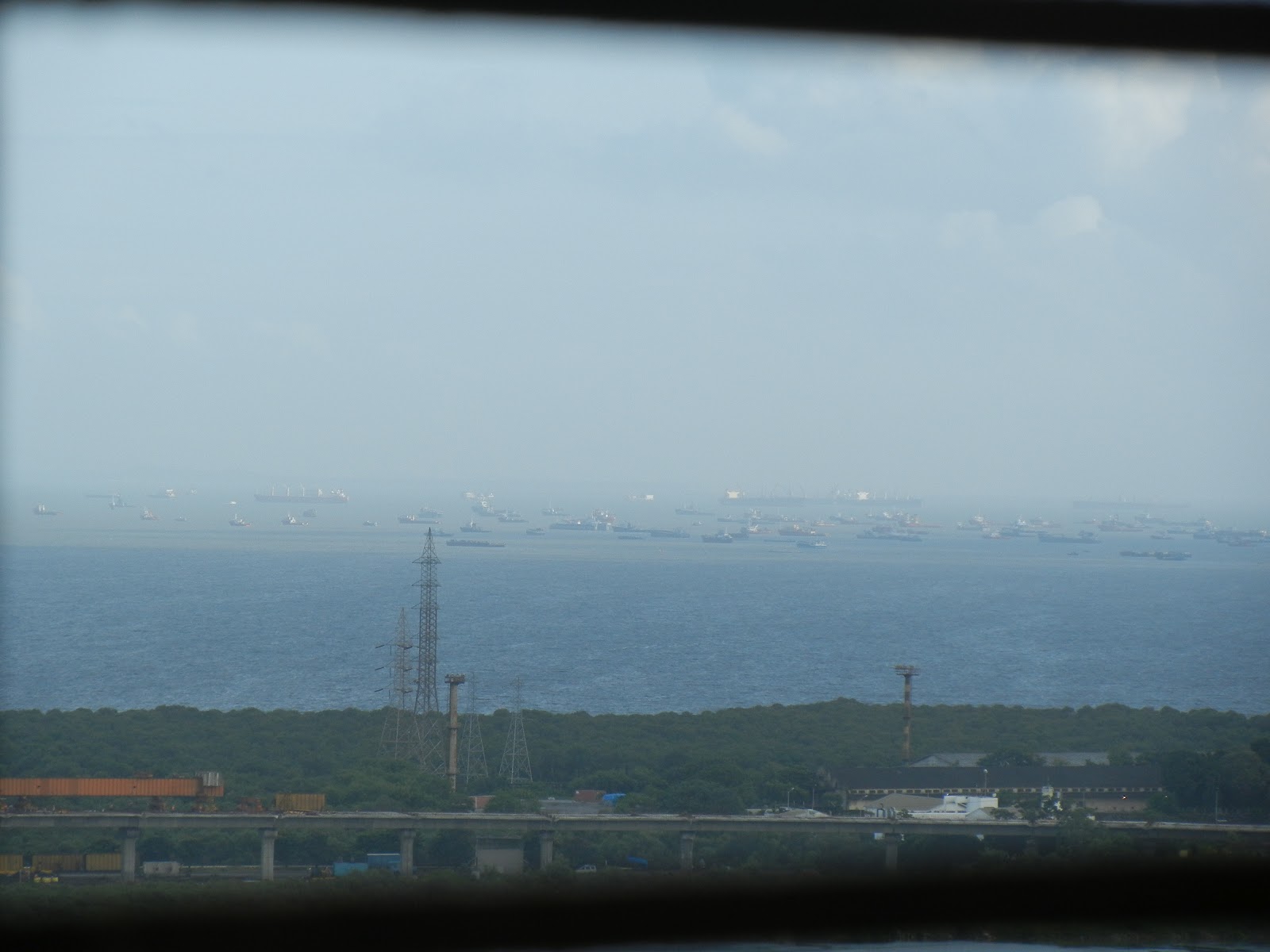
Mordor and the Eye of Sauron - view from flat
On a clear morning - view from flat

After rains - view from flat

All shades and colours - view from flat
VT in the rain

Long Dinners and Great Memories
Waiting for a taxi - The only city in India where queues are formed, sometimes, at certain spots
My weekly headline provider on way to work - the very up-to-date Amul hoarding at Tilak Bridge
Beach and Bridge, Dadar

I will not let Delhi scare me - "jaisi billi maari, vaisi Dilli maari"


Salaam Bombay - Five things I'll miss.

It's my last night in Bombay and these are the five things that I will miss most about this great city:

1. The Parsis

I've found the Parsis fascinating as a people ever since one of my junior school textbooks informed me that Dadabhai Naoroji, the Grand Old Man of India, was a Parsi and all subsequent interactions have only reinforced my fascination. They laid the foundations of the city and continue to be the vortex around which the city revolves; somehow, I believe it is the presence of the Parsis that makes Bombay so different from any other in India - in terms of safety, culture (they turn up in all full force and of all ages at all events at the NCPA) and of course, the urban space that is South Bombay.

The Grand Old Man of India at Flora Fountain
2. King's Circle

Located ten minutes from my flat and on my route back from work, King's Circle provided me with all my necessities - an ATM, a grocery shop, a cobbler, a florist, a miscellaneous items shop, an ice-cream parlour, the chemist and most importantly, a second-hand book spread and Mysore Cafe.

Mumbai does not have very many good, or even just very many book shops. However, one does find the most beautiful second hand books. While King's Circle has many booksellers selling pirated and second hand copies, my favourite book-spread was to the left of Mysore Cafe from 5 p.m. to 9 p.m. and  a most eclectic collection it is . The book-seller is knowledgeable, very helpful and never over-charges. Never having needed to bargain, I have usually ended up buying more books than I ought have but as I mentioned before, some of my favorite buys have been from there, including:
  • Two Historic Trials in Red Fort - an account of the INA Trial and the Trial of Bahadur Shah Zafar complete with all documents including statements, exhibits, opening statements, arguments et al
  • The Adventures of Hajji Baba of Ispahan
  • Hard cover copies of selections of stories by Mark Twain, O. Henry and Guy de Maupassant
  • The Collected DC Comics Absolute Justice
  • Verse by Soviet Poets who laid down their lives in the Great Patriotic War of 1941-1945
  • A Ramayana in Sindhi written in a variant of the Arabic scrip and a Persian Primer
My book-buying was usually proceeded by dinner at Mysore Cafe, one of the many numerous Udipi cafes dotting this area - I grew to prefer it over its rivals for its rasam-vada, its proximity to the books, their providing me with an individual table even if I went alone, their letting me sit for many hours without ordering and for remembering my usual and specific orders.

Cafe Mysore, King's Circle

 Covered from the rain - the book-seller's spot, King's Circle

3. The Taxi Drivers

I have taken the ubiquitous yellow-black cab off the roads of Bombay at all times of the night and day during my stay here and (with a certain amount of luck, of course), I have never faced any problems. In the insane traffic of this city, I have carried on extended conversations with the taxi-drivers and exchanged notes on our experiences in the city and its politics and the state of the country and everything else.  And I have often slept soundly on my way to work on certain days in the confident knowledge the taxi would wind its way to its destination. And though it is almost a daily battle to find a taxi home, I have had, on the whole, a most interesting time with the taxi drivers of Bombay and they will be sorely missed.

I am yet to reach Delhi and I have already been warned time and again against beginning any polite conversations with the taxi- and auto- drivers in Delhi.


4. The Freedom of Movement

No poky neighbours, no judging stares in public spaces and no self-imposed time limits for being out and about town. No other city in India to give that kind of freedom.

5. South Bombay

Everything about it! Marine Drive, Causeway, Mondegar's, Gateway, the Taj, Kala Ghoda, Fountain, VT, Prince of Wales Museum, the Reading Room, Brittania and tree-lined roads to walk along.

Marine Drive

The best place to hang-out late into the night, Marine Drive

Tree-lined avenues, Ballard Estate

The 24-hour open study centre

Boy reading a book, near Cafe Universal, Fort

Thursday, August 9, 2012

Ramzan Special - Plato Spotting and Gorging in the by-lanes of Mumbai.

To add to a previous post, here's Shahi Aflatoon spotted at Mohammed Ali Road, Mumbai during the month of Ramzan.


I didn't get the chance to try the Plato special but we did have a most filling and wonderful dinner in a most festive atmosphere.


I have a sweet tooth and I wish I'd gone a little slow on the dinner and kept space for the many varieties of desserts available - including many that I hadn't heard or seen before! But maal-poora is one of my favorite dishes, and Ramzan is occasion for this special maal-poora (the photo below), the size of the dinner plate with phirni. What a perfect end.


Ramzan Mubarak!